

The PhD candidates of the 2025 program
Discover the portraits of the 10 PhD candidates who have been awarded a PhD fellowship by InLife & IPV.
Pauline Autin
Après deux années en classe préparatoire aux grandes écoles (filière PCSI-PC), j’ai poursuivi mon cursus à Sorbonne Université, d’abord en troisième année de licence mono-disciplinaire de physique puis en Master 1 de Physique fondamentale et appliquée (PFA). J’y ai découvert la biophysique, un domaine qui m’a poussée à m’orienter vers le Master 2 Systèmes Biologiques et Concepts Physiques (SBCP). Je prépare actuellement une thèse de doctorat en biophysique au laboratoire Jean Perrin.
Titre et résumé de la thèse : Étalement de colonies de bactéries par effet Marangoni.
Lorsque l’on dépose une colonie de Pseudomonas aeruginosa sur un gel d’agar, celle-ci s’étale en formant des motifs branchés. Ce phénomène résulte d’un couplage entre des facteurs biologiques tels que la motilité bactérienne, et de processus physiques. Ces derniers sont induits par la sécrétion de diverses substances par les bactéries, notamment des tensioactifs. L’objectif de ma thèse est de proposer un modèle physique capable d’expliquer l’émergence de ces motifs, en me fondant principalement sur une approche expérimentale, appuyée par des arguments théoriques.
Simon Berthe
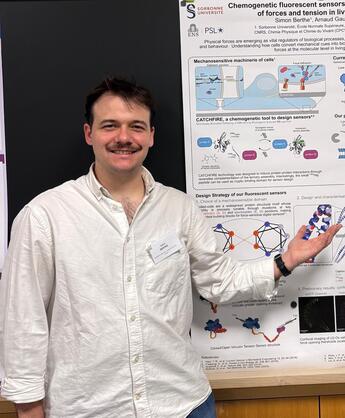
After graduating from the AbiBac franco-german high-school program in 2020, Simon studied chemistry and biology at the Université Clermont Auvergne, where he developed a strong interest in biochemistry and the interplay between the chemical structure and biological function of proteins. Building on this, he joined the Chemistry and Life Science Master program between Paris Sciences et Lettres and Sorbonne University to deepen his expertise at the interplay between chemistry and biology. During this master, Simon joined Pr. Arnaud Gautier lab at Sorbonne Université, where he worked on the design of innovative chemogenetic tools to study living systems. He then successfully competed for a doctoral fellowship through the Interface for Life program, receiving funding for a PhD project focused on designing chemogenetic fluorescent sensors to study forces in mammalian cells, under the supervision of Pr. Arnaud Gautier and Dr. Franck Perez.
Title and summary of the PhD project: Chemogenetic fluorescent sensors to study the role of forces and tension in intracellular trafficking
Physical forces are emerging as vital regulators of biological processes, controlling cell migration, differentiation, and behaviour. Understanding how cells convert mechanical cues into biochemical signals requires tools to measure forces at the molecular level in living cells. The goal of this PhD project is to design innovative chemogenetic fluorescent sensors to overcome limitations of available sensors.
These sensors are built around protein systems that undergo force-induced unfolding, exposing a cryptic peptide target that can reversibly recruit a larger protein counterpart. In the presence of a fluorogenic molecule, this recruitment produces a fluorescent signal only when a defined force threshold is reached within mechanosensitive proteins, making the sensor both specific and tunable. These sensors will then be used to investigate the role of mechanotransduction in key cellular processes, with a particular focus on the protein secretion pathway.
Emmanuelle de Bressy
Après un diplôme d'ingénieur en Génie Biologique obtenu à l'Université de Technologie de Compiègne en 2024, j'ai travaillé un an en tant qu'ingénieure qualité dans la robotique chirurgicale, avant de commencer ma thèse en octobre 2025.
Titre et résumé de la thèse : Ingénierie de la diversité des fibroblastes
L'objectif de ma thèse est de comprendre comment une cellule progénitrice peut se différencier en un fibroblaste spécifique des différents types de tissus conjonctifs de l'attachement musculaire. J'identifierai pour cela les signaux moléculaires, l'environnement 3D et les paramètres mécaniques qui influent sur la différenciation, en utilisant des approches combinées de biologie du développement et d'ingénierie tissulaire. Cela pourrait permettre de mieux comprendre les mécanismes liés à la fibrose observée dans la cicatrisation des tendons et les dystrophies musculaires.
Elisa Bouvier
I began my academic journey in 2020 at Sorbonne University by enrolling in a bi-disciplinary bachelor’s program in Chemistry and Biology, including a final year as an exchange student at University of Toronto. I then pursued a Master’s degree in Chemistry for Life Sciences at PSL University and Sorbonne University, during which I completed several research internships at the interface of chemistry and biology, focused on the development of innovative therapeutic strategies. These experiences ultimately led me to my PhD project, which I started in October 2025 under the joint supervision of the Chembio team at the IPCM laboratory at Sorbonne University and the TGF-β team at the Saint-Antoine Research Center.
Title and summary of the PhD project: Design and development of MetalloPROTACs, an anticancer strategy for the targeted degration of proteins of interest
Since the discovery of cisplatin, metal-based compounds have attracted considerable interest in cancer therapy, although their clinical application remains limited by selectivity issues. Improving their efficacy therefore requires a deeper understanding of their mechanisms of action and biological targets. Recently, the ChemBio team at IPCM developed iridium(III)-based compounds, among which a promising candidate was shown to target Hsp90, a key molecular chaperone involved in the folding of oncogenic proteins. Hsp90 plays a central role in protein quality control by promoting either protein stabilization or proteasomal degradation, making it an attractive therapeutic target in cancer. In parallel, PROTAC technology has introduced novel strategies for targeted protein degradation, although current limitations call for alternative approaches. This interdisciplinary doctoral project aims to design and synthesize iridium-based metalloHEMTACs that exploit Hsp90–E3 ligase interactions to induce proteasomal degradation of oncogenic proteins. As a proof of concept, CDK4/6 kinases, which are overexpressed in cancer cells and involved in therapeutic resistance, will be targeted.
Jackson Carter
My name is Jackson Carter, and I am originally from Boulder, Colorado in the United States. I studied fundamental physics at Paris-Saclay University (BSc, 2022) and theoretical physics at ENS-PSL (MSc, 2024). During my studies, I completed internships in stellar astrophysics at the Institut d’Astrophysique Spatiale (IAS) and in mathematical physics at Durham University, where I worked on topics related to quantum gravity. More recently, I have been interested in artificial intelligence and its applications to biology. I studied paleontology and evolutionary biology at the Muséum national d’Histoire naturelle (MNHN) and completed an internship at the CR2P, where I used deep learning methods to reconstruct damaged fossil material. This experience led to my current PhD project.
Title and summary of the PhD project: Beyond 3D Geometric Morphometrics via Deep Learning
My current research focuses on developing new deep learning approaches to analyze biological shapes in 3D. Traditionally, morphology is studied using geometric morphometrics, which relies on selected anatomical landmarks but may overlook much of the information contained in full 3D structures. In contrast, my work explores methods that directly process 3D meshes, enabling more comprehensive and automated analyses. In particular, I work with methods from geometric deep learning, such as neural flows, functional mapping, and optimal transport, which allow us to quantify shape differences directly. I also use graph neural networks to generate class activation maps, enabling us to visualize which regions of 3D structures differ across species or groups.
During my PhD, I will develop and validate these methods on datasets of modern vertebrates, before applying them to fossil material. In particular, I aim to study morphological variation in a large population of Cretaceous dinosaurs from the Angeac-Charente site. This work seeks to contribute to new, data-driven approaches for studying shape evolution in biology and paleontology.
Sam Gaborieau
Après avoir fait une licence et mon M1 de physique à Sorbonne Université, j’ai réalisé le M2 MMMP (Physique Macroscopique et Modélisation Mathématiques) entre Dauphine et l’ENS, durant lequel j’ai fait un stage de biophysique au Collège de France. Après cela, j’ai rejoint le M2 ICFP (International Center for Fundamental Physics) dans le parcours de Matière Molle et Biophysique. Cela m’a amené à faire mon stage au PMMH sur le mouvement collectif des poissons, qui a finalement mené à une thèse sur le même sujet.
Titre et résumé de la thèse : Étude numérique et expérimentale des transitions de phase dans le mouvement collectif des poissons
Ma thèse consiste à étudier comment des perturbations des mécanismes sensoriels dans les interactions locales entre les individus amènent à des transitions de phase dans le mouvement global du banc de poissons. Un exemple de perturbation est un changement de luminosité, qui va altérer leur vision. On étudie leurs mouvements par des expériences contrôlées en laboratoire sur des groupes de poissons, et on essaye de reproduire ces mêmes comportements par des simulations d’un modèle mathématique.
Andrea Tarabini
A longstanding interest in genetics led me to pursue a Bachelor’s degree in Biological Sciences at the University of Milano-Bicocca, graduating in 2022 with honors. During my undergraduate studies, I developed a strong focus on DNA as the molecule that encodes the information underlying the complexity and diversity of living systems. In the final year of my Bachelor’s degree, I was introduced to bioinformatics, which provided me with a new perspective on biological research. The possibility of interrogating complex biological questions through an interdisciplinary approach, which integrates heterogeneous datasets, firmly motivated me to further specialize in this field. I subsequently pursued a Master’s degree in Bioinformatics for Computational Genomics, a joint degree between the University of Milano-Statale and the Politecnico di Milano, graduating in 2025 with honors. This academic program allowed me to consolidate my background in genomics and to develop the quantitative and computational skills required to analyze large-scale and complex biological datasets. My progressive transition from classical biology to computational genomics has been guided by a overarching interest in understanding genome structure and function; I am truly delighted to have the opportunity to investigate these topics in a research-oriented environment and to further my training through the IPV Doctoral Program.
PhD thesis title and summary: Impact of Structural Variants on Genome and Proteome Evolution in Saccharomyces cerevisiae
Structural Variants (SVs) are genomic rearrangements affecting DNA on a large scale. By altering gene dosage, disrupting coding sequences, or creating novel gene fusions, SVs are more likely to affect gene function than Single-Nucleotide Variants (SNVs). Yet the functional and evolutionary impacts of SVs remain poorly understood, reflecting their greater complexity of detection compared to SNVs. The advent of Long-Read Sequencing Technologies (LRST) has alleviated historical limitations in SV calling, enabling the assembly of reference-quality genomes at population scale and fostering the shift toward a pangenome paradigm. Leveraging LRST, we generated the S. cerevisiae Reference Assembly Panel (ScRAP), the first yeast reference pangenome, comprising telomere-to-telomere genomes from hundreds of strains spanning the species genomic space. ScRAP has revealed over 36000 SVs, many of which affect protein-coding genes. However, the functional consequences of these variants on gene expression and protein evolution remain largely unexplored. This doctoral research project aims to characterize the impact of SVs on gene repertoire evolution and quantify their effects on gene expression at the proteomic level. By leveraging ScRAP and newly generated quantitative proteomics data, we will assess how SVs influence protein abundance and uncover novel SV derived proteins, including de novo and chimeric proteins. We will further investigate the structural properties of these newly emerged protein domains to assess the contribution of SVs to the evolution of protein folds. Finally, we will explore the evolutionary and adaptive significance of SVs by associating their presence with phenotypic traits across ecological niches. By combining expertise in yeast genetics and computational biology, this project aims to provide novel insights into the role of SVs in gene expression, highlighting how large-scale structural rearrangements drive genome evolution and molecular innovation.
Varmitha Thiruchelvam
Driven by a strong interest in research bridging biology and chemistry, I first completed a bachelor’s degree at Université Paris-Saclay, where I developed a solid foundation across both disciplines. Eager to further develop my expertise in chemistry, I then chose to specialize in molecular chemistry through a master’s program. In the second year of my master’s degree, I joined the CPCV laboratory at Sorbonne Université, where I worked on cell-penetrating peptides derived from homeoproteins, a project at the crossroads of chemistry and biology. I am currently pursuing this line of research through a PhD funded by the IPV and InLife doctoral programs, where I continue to develop my project at the interface of biology and chemistry.
Title and summary of the PhD project: New chemically engineered homeoproteins and derived cell-penetrating peptides with improved properties for therapeutic applications
Homeoproteins (HP), key regulators of gene expression, contain a cell-penetrating domain (CPP domain) within their sequence. This doctoral project seeks to develop chemically modified homeoproteins and CPP derivatives with enhanced cellular uptake and therapeutic efficacy by substituting a critical residue involved in the HP internalization process. To achieve this, new non-canonical amino acid analogues will first be designed, synthesized, and incorporated into a CPP derived from a homeoprotein, with the goal of enhancing internalization efficiency. The most promising synthetic amino acid analogues will then be incorporated into the full-length protein. Synthesis will rely on solid-phase peptide synthesis (SPPS) and native chemical ligation (NCL) to overcome technical limitations related to the size and chemical nature of modified HP. The biological properties of the CPP and HP derivatives will be evaluated, including cytotoxicity, internalization efficiency, and intracellular targeting. Structural and biophysical (NMR, ITC, DC) studies will also be conducted.
This interdisciplinary project, co-supervised by the CPCV (Sorbonne Université) and BioCIS (CYU) laboratories, will provide a better understanding of the mechanisms of HP and CPP cellular entry and enable the design of innovative peptide vectors. It will lay the groundwork for future therapeutic developments based on chemically enhanced HPs with improved cellular penetration capabilities.

Yi Yuan
Diplômée d’une licence en sciences biomédicales à l’Université Paris Cité, j’ai poursuivi mes études en master Chimie et Sciences du Vivant à PSL et Sorbonne Université, avec une spécialisation à l’interface entre chimie, biologie et biomatériaux. Au cours de mon parcours, j’ai développé une expertise en synthèse de nanomatériaux, de biomolécules et de petites molécules, ainsi qu’en caractérisation physico-chimique et en biologie cellulaire. Mes expériences en recherche, notamment à l’ENS-PSL et à l’ETH Zürich, m’ont permis de travailler sur des nanoparticules théranostiques, des catalyseurs biomimétiques et des agents d’imagerie innovants.
Titre et résumé de la thèse : Antioxydants à base de manganèse et délivrance
Les maladies inflammatoires intestinales sont liées à un déséquilibre du stress oxydatif dans les cellules intestinales. Cette thèse s’appuie sur des complexes de manganèse qui sont capables de mimer l’activité d’enzymes antioxydantes naturelles.
Mon travail consiste à concevoir et synthétiser des dérivés de ces complexes afin d’en améliorer la stabilité dans des environnements biologiques complexes. Ces composés seront ensuite encapsulés dans des vésicules extracellulaires, utilisées comme vecteurs biologiques pour favoriser leur protection, leur ciblage et leur efficacité.
L’objectif est de développer une stratégie innovante combinant chimie de coordination et systèmes de délivrance biologiques pour renforcer l’activité anti-inflammatoire et ouvrir de nouvelles perspectives thérapeutiques.